

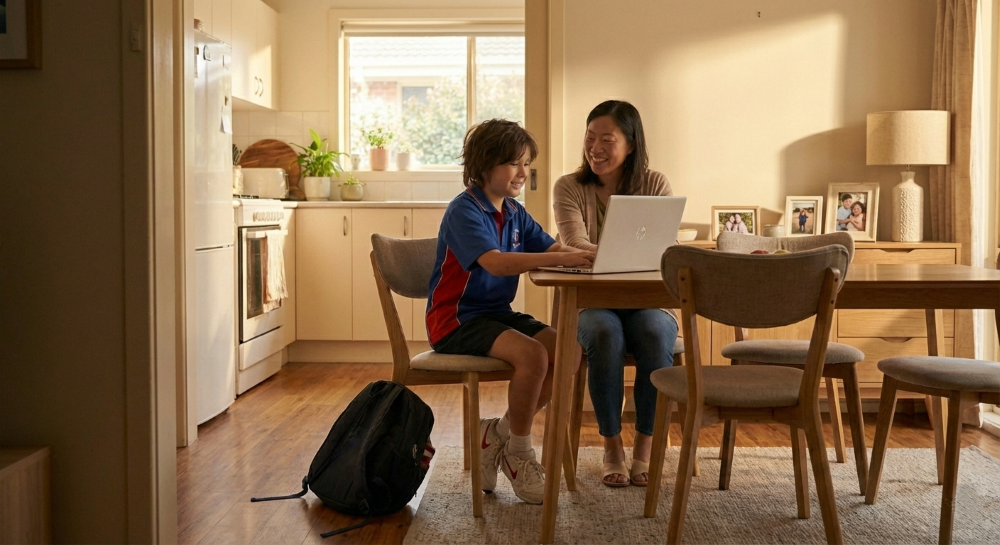
Ask most parents what they want for their child's education and, sooner or later, you land on the same word: independent. We picture a child who can sit down, get on with it, and work through something hard without us hovering at their shoulder. Here's the part that's easy to miss - independence isn't a personality type that some lucky children are simply born with. It's a set of skills and habits. And the primary years are when the foundations are poured.
This is a practical guide to how to raise an independent learner: what independent learning actually looks like at primary age, why the early years are the window, and the building blocks you can start on this term.
What independent learning really means at primary age
Independent learning isn't leaving your child to sink or swim. It's the growing ability to start a task, stick with it when it gets tricky, and get themselves unstuck - with less and less help from you over time. Put simply, it's when a child begins to take ownership of their own learning.
It also looks different at each age. For a Year 2 child, independence might mean getting their reading book out and settling into it without a reminder. For a Year 6 child, it might mean planning how they'll tackle a project over a week. The target moves as they grow, but the direction is always the same: from "do it with me" to "do it near me" to "do it yourself".
Why the primary years are the window
Habits and self-belief form early, and they compound. A child who learns in Year 3 that effort pays off, that being stuck is normal, and that they can find their own way through, carries those beliefs into every year that follows. It is far easier to build good patterns now than to unpick unhelpful ones later.
The primary years are also low-stakes in the best possible way. A wrong answer on a Tuesday-night worksheet costs nothing. That makes now the ideal time for your child to practise struggling, trying, and recovering - long before the work gets harder and the stakes get higher in high school.
The parent's real job: coach, not co-pilot
Here's the paradox at the heart of raising an independent learner: the more you do for your child, the less capable they become. Every time we jump in with the answer, we send a quiet message - "this is too hard for you, let me". Do it often enough and the child comes to believe it.
The shift that helps is from co-pilot to coach. A co-pilot takes the controls. A coach stands on the sideline, asks good questions, and lets the player make the play. In practice that means:
- Ask instead of tell. "What's the first step?" beats "Here's what you do." Questions hand the thinking back to your child.
- Let productive struggle happen. A few minutes of being stuck isn't a problem to rescue them from - it's where the learning lives.
- Scaffold, then fade. Help a lot at first, then deliberately help a little less each time, until they don't need you for that task at all.
- Praise effort over grades. Point to how they got there, not just the mark. Children who value effort are the ones willing to attempt things they might get wrong.
The four building blocks of independent learning
Independent learning rests on four things you can nurture directly. Each is worth a deeper look on its own, but here's how they fit together.
1. Habits and routine. Independence needs a predictable frame to grow inside. A consistent time and place for learning, in short focused blocks suited to your child's age, removes the daily negotiation and makes getting started automatic.
2. Motivation. The goal is a child who wants to learn, not one who performs for rewards. That comes from autonomy (a say in how and when), curiosity (following what interests them), and praise aimed at effort and strategy rather than only the right answer.
3. Confidence. Self-belief is the engine of independence. It's built by stacking small, achievable wins until "I can't do this" becomes "I can work this out". Confidence is a consequence of small successes, not a pep talk.
4. Getting unstuck. This is the meta-skill that ties the others together - knowing what to do when you don't know what to do. Re-read the question, look back at a worked example, try a smaller version first, or ask for a nudge rather than an answer. A child with a few of these strategies is never truly stuck.
Balancing support and independence
Stepping back doesn't mean stepping away. Your child still needs support - the skill is knowing what kind, and when.
It helps to notice that the moments your child needs you tend to fall into two shapes. Sometimes there's a concept they simply haven't understood, and they need it taught properly by someone who knows the material and the way it's taught today. And sometimes they've understood the idea but are stuck on one step, in the moment, and just need a small nudge to keep going. These call for very different responses - and neither one requires you to have all the answers. (If you've hit the point where you can't help with the work yourself, that's incredibly common — here's what to do when you can't help with the homework.)
Where tools and tutoring fit
You don't have to be both the subject expert and the always-available helper. That's a lot to carry, and it's often the thing that turns homework into a nightly battle.
For the concept gap, a specialist Cluey tutor can teach the material one-to-one, in the way it's actually taught now - in Maths or English, from Year 2 upwards. For the in-the-moment gap, Cluey Plus gives your child support between times: Video Lessons to revise at their own pace, with guided practice to make it stick, and Ask a Question, available 24/7, to get a guided nudge when they're stuck and you can't help. Crucially, it's designed to walk them through the thinking rather than hand over the answer - the kind of help that builds independence instead of replacing it. Cluey Plus is a great complement to tutoring, and it's included free with any tutoring subscription (also available as a standalone subscription, with a free 14-day trial and no credit card). Together they form a continuous learning loop that keeps your child progressing between sessions.
The point isn't to simply outsource your child's learning support. It's to make sure that when they hit a wall, there's the right kind of help on hand - so the habit they build is "find a way through", not "wait for Mum or Dad".
Learn more about Cluey’s learning support options at clueylearning.com.au and plus.clueylearning.com.au.
The long game
It's easy to measure success by tonight's finished worksheet. The better measure is quieter: a child who needs you a little less this month than last. That's the whole project. You're not managing this week's homework - you're raising a learner who will still be learning, on their own steam, long after they've left your kitchen table.
Start with one building block. Pick the one your child needs most right now, work on it for a few weeks, and let the wins build from there.
.png)
.webp)