

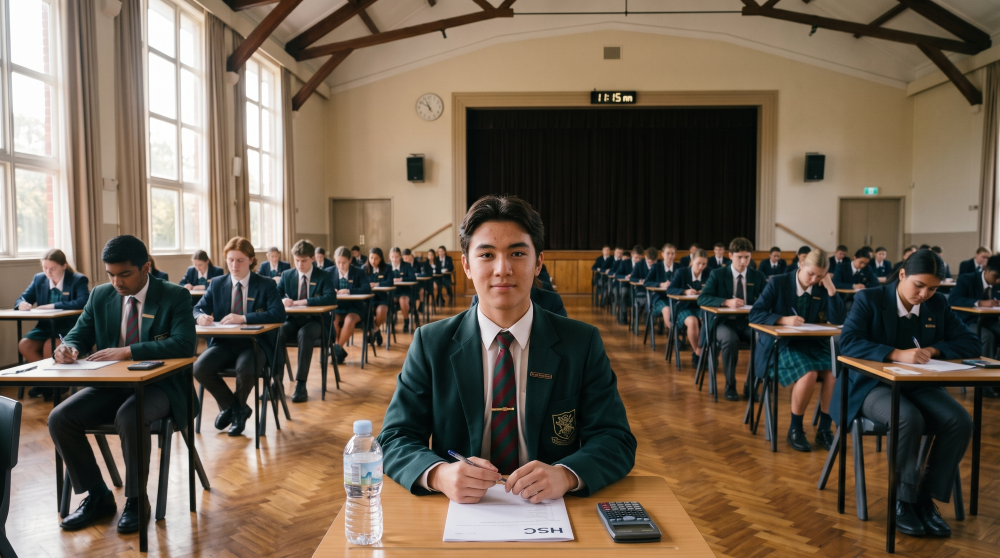
For most of the country, Year 12 exams arrive in two waves. First come the trial exams - depending on the school and state, your child might hear them called trials, practice exams, or mocks - which usually fall in the second half of Term 3, around August and September, though in some states they begin in late July. Then the final external exams follow across October and November. Either way, the two waves ask different things of your child, and different things of you.
Most parents want to help and aren't sure how. You can't sit the exam for them, and you probably can't explain the chemistry. But there's a real job here, and it's one you're well placed to do: hold the conditions steady so your child can do their best thinking. Here's how.
Get clear on what they’re actually facing
Before you can help, it's worth understanding the shape of the term ahead - because your child may not have mapped it out themselves.
Trial exams matter for reasons beyond practice. In many states, trial results feed into a student's school assessment marks, which contribute to their final result. The exact weighting varies by state, subject, and school, so the most useful thing you can do is ask your child's teachers - or your child - how the trials count for them. That single question turns a vague fog of pressure into something concrete you can plan around.
The final exams are the external ones: the HSC in New South Wales, the VCE in Victoria, the QCE in Queensland, the WACE in Western Australia, the SACE in South Australia, and their equivalents in Tasmania and the Northern Territory. These are marked externally and sit at the end of the year. (The ACT is the one place that doesn't run external subject exams at all - see the note on your state below.)
Once you both understand the calendar, you can help with the thing students most often get wrong - not the studying itself, but the plan behind it.
Help them study smarter, not just longer
The most common Year 12 study mistake isn't laziness. It's the opposite: pouring hours into re-reading notes and revising every topic evenly, right up to exam day. It feels productive. It mostly isn't.
Re-reading gives the comforting sense that you know the material, because it's all familiar as it passes in front of you. But recognising something on the page is not the same as being able to produce it under exam pressure. The students who improve fastest do two things differently. They find out precisely where the gaps are, and then they spend their limited time there - not everywhere.
That means self-testing before revising. A short quiz on a topic will reveal, in ten minutes, what an afternoon of re-reading will hide: the concepts that aren't secure yet. This is where a tool like Cluey Plus earns its place in the study routine. Its Take a Quiz feature runs quick, syllabus-matched quizzes so your child can see exactly which topics are shaky, then aim their revision at those instead of drifting across everything. Practice Exams take it a step further, letting them rehearse full papers under timed conditions so the real thing feels familiar rather than foreign.
You don't need to run any of this yourself. But you can ask the question that nudges it along: “Do you actually know which topics are your weakest right now?” If the honest answer is “not really,” that's the first thing to fix.
Protect the fundamentals - that’s your lane
Here is the part only you can do. Your child can find their own study method, but they will quietly let sleep, food, and downtime slide as the pressure builds. Protecting those is genuinely your job, and it matters more than most parents realise.
Sleep is not optional revision time to be traded away. A student who studies until 1am and sits an exam on five hours' sleep will underperform relative to what they know - tired brains retrieve information slowly and make careless mistakes. A consistent bedtime through exam weeks does more for a result than the extra hour of cramming it replaces.
The rest is unglamorous and effective: regular meals so they're not running on toast and energy drinks, a bit of movement to burn off nervous energy, and permission to stop. A walk, a proper dinner together, an evening off before a big paper - these aren't distractions from the work. They're what makes the work stick.
Manage the emotional temperature
Year 12 carries a particular weight, and a lot of it is about the ATAR. It helps to keep that number in proportion, out loud, more than once. An ATAR opens doors to university pathways, but it isn't a verdict on your child, and it's far from the only route to where they want to go. Early-entry schemes, portfolio pathways, TAFE, gap years, and course transfers all exist. Students who believe their whole future hinges on one number tend to freeze; students who see it as one door among several tend to perform better under pressure.
Your tone sets the temperature in the house. If every conversation becomes “have you studied?”, you become one more source of stress rather than a refuge from it. A more useful question is simply, “What would actually help you right now?” - which might be a quiet house, a lift somewhere, or being left alone for an evening.
Watch, too, for the difference between ordinary exam nerves and something heavier. Persistent sleeplessness, withdrawal, or a child who seems to have stopped coping rather than just feeling stressed is worth a gentle conversation, and sometimes a chat with the school or a GP. Supporting the person always comes before supporting the student.
Know when to bring in extra support
There's a specific moment most Year 12 parents recognise: it's 9pm, your child is stuck on a past-paper question in a subject you last studied decades ago, and there's no one to ask. The frustration in those moments does real damage to momentum.
This is where structured support helps - not to replace your child's own effort, but to catch them when they're stuck. Cluey Plus is built around exactly these moments. Ask a Question gives them a way to get unstuck on a specific problem when no one's around to explain it. Review My Work gives feedback on written responses, which is often the hardest thing to self-assess in English. And because it's built on the actual senior syllabus rather than the whole internet, the help they get is aimed at what they're actually being examined on - not a generic version of the topic.
The point isn't to hand everything to a platform. It's to make sure that when your child hits a wall at 9pm, the wall isn't the end of the session.
What this looks like in a typical week
Picture a fortnight before trials. On Sunday, your child spends fifteen minutes mapping the week: which subjects, which topics, which day. Early in the week, they run a few short quizzes across their weaker subjects and discover that in Chemistry, it's specifically the equilibrium topics that aren't secure - not the whole course. So the Chemistry revision that week targets equilibrium, not a re-read of the entire textbook.
Midweek, they sit one past paper under timed conditions, then use the marking guide (and, for the written sections, feedback on their responses) to see where marks were lost. They re-learn the one concept that tripped them up. Thursday night, they're in bed by a reasonable hour because Friday's a big day. Across all of it, you've done the driving, the dinners, and the occasional “you've done enough for tonight.”
That's the rhythm. Targeted effort, honest feedback, protected rest - repeated. It beats twelve unfocused hours every time.
Give your Year 12 student the right kind of help
The best support you can offer this exam season is a mix of steady conditions at home and the right tools when they're stuck. Cluey Plus brings together quizzes to find the gaps, practice exams to rehearse under pressure, and on-demand help for the moments you can't cover - all matched to the senior syllabus your child is actually sitting.
Start a free Cluey Plus trial →
See how your Year 12 student studies with it before you commit to anything. No lock-in - cancel any time.
.png)
.webp)